When Fire Protection Investment Didn't Reduce Insurance Premium
A technical EHS professional shares a real-world insight: why investing in world-class fire risk infrastructure didn't reduce insurance premiums—and what behavioral safety has to do with it.
When Fire Protection Investment Didn't Reduce Insurance Premium
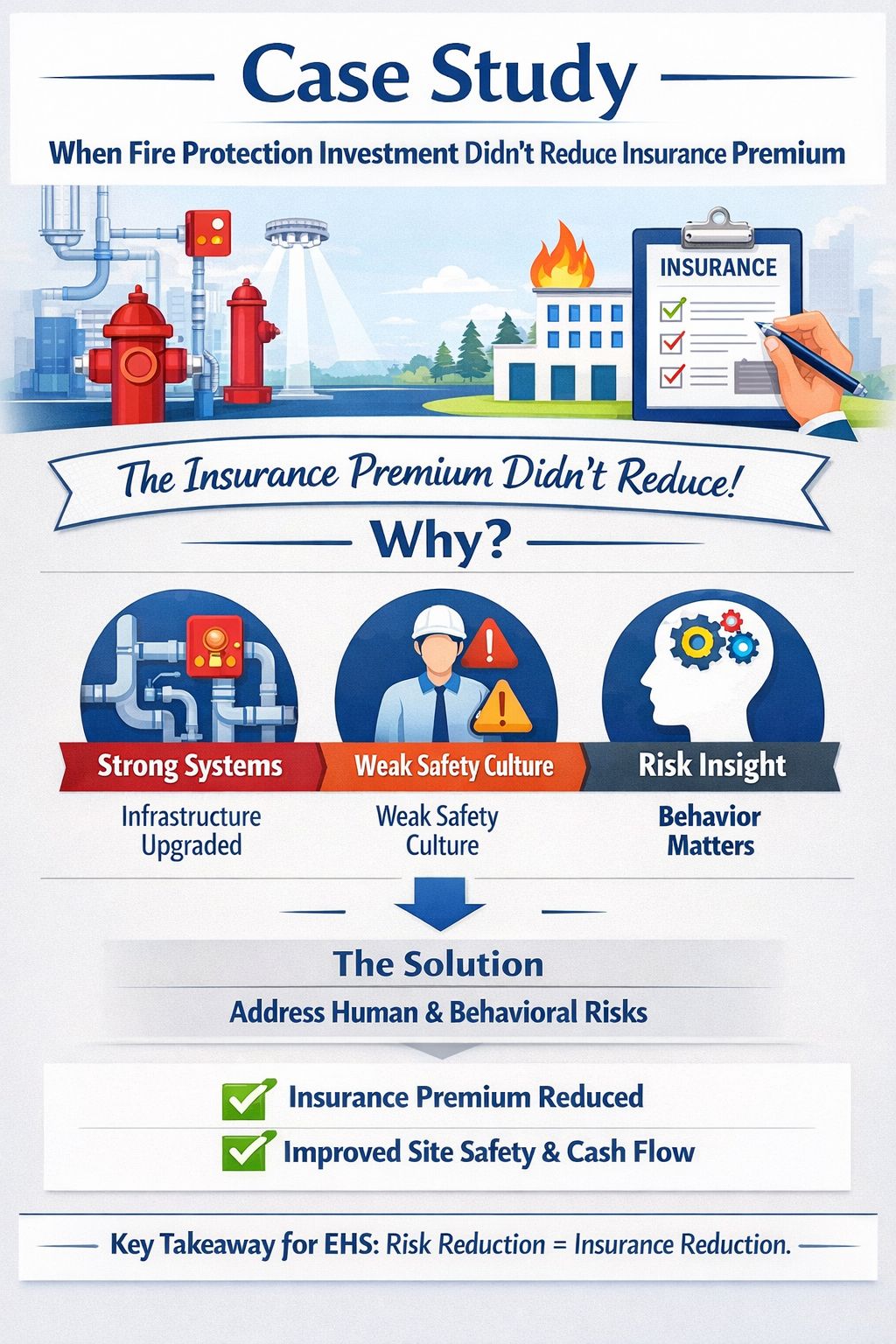
Early in my EHS career, our site had invested heavily in fire risk reduction—hydrants, pumps, sprinklers, alarms—fully compliant and well maintained.
From a technical standpoint, the infrastructure was strong, and an industrial insurance policy was in place.
Yet, the insurance premium didn't reduce.
This raised a basic question:
If fire risk has reduced, why hasn't the insurance cost followed?
Insight from the Insurer
When we pressed for an explanation, the insurer was candid:
Risk is not driven by systems alone. Human behavior and safety culture are decisive. Even with world-class infrastructure, unsafe practices and weak discipline can still lead to major losses.
This was a pivotal moment in my understanding of how insurance risk assessment actually works.
Methodology: The Missing Link
Each site risk is assigned a risk mark score. Here's how it works:
-
Infrastructure upgrades reduce technical risk scores — Better hydrants, pumps, sprinklers, and alarms directly lower the measurable risk component.
-
But human-related risk acts as a multiplier across all risks — Behavioral safety and discipline don't just add to risk—they amplify or reduce the entire risk profile.
-
If behavioral risk doesn't improve, overall risk profile shows only marginal improvement — regardless of capital investment in physical infrastructure.
In mathematical terms:
Overall Risk = Technical Risk × Behavioral Risk Multiplier
If behavioral risk remains high, even excellent infrastructure won't move the needle.
We also realized insurance goes beyond property damage—it covers business interruption and opportunity loss, often the biggest financial exposure for industrial sites.
Action & Outcome
The path forward required cross-functional engagement:
- EHS — Demonstrating loss prevention maturity
- Operations — Showing behavioral safety practices on the ground
- Finance — Connecting safety performance to cost of risk
- Insurers — Communicating risk improvements in terms they value
The focused engagement helped us clearly demonstrate both our infrastructure investment and our behavioral safety maturity.
Result:
- ✅ Insurance premium reduced
- ✅ Positive impact on site cash flow
Key Takeaway for EHS Professionals
Good EHS should not stop at compliance.
It must translate into risk reduction—and risk reduction must reflect in insurance premiums. That's when EHS truly becomes a business value creator, not just a compliance function.
The lesson is simple: Physical systems matter, but behavioral safety is the multiplier that determines whether your investment actually pays off.
About the Author: Nilesh Mehta is the founder of Vardasustain Consulting, specializing in EHS and ESG implementation across manufacturing industries. With deep experience across FMCG, Cement, Automotive, and Chemical sectors, he helps organizations demonstrate EHS as a strategic business value driver.